
Identification
Why bird colors change with the light
Retain useful evidence when shade, glare or backlighting distort color.
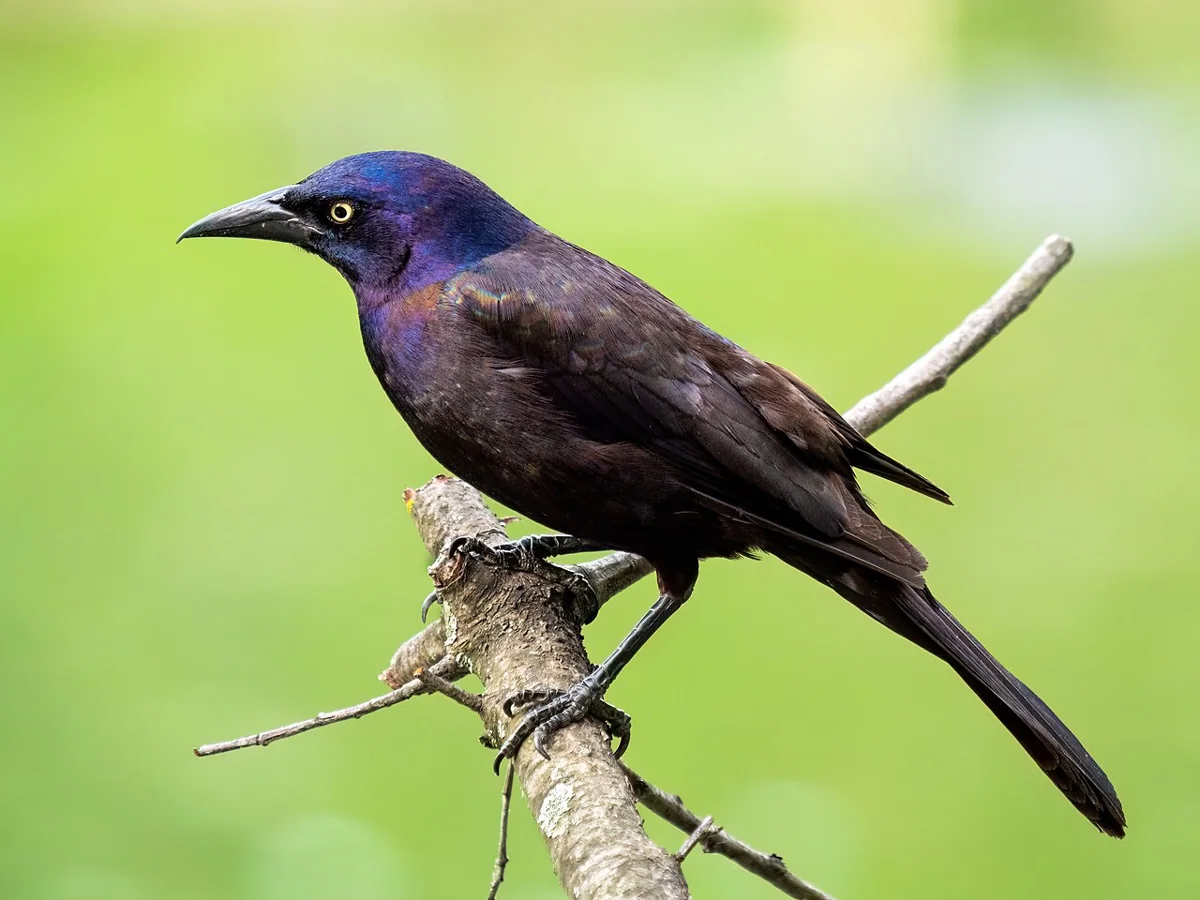
A bird crosses from sunlit grass into shade and seems to change color. Another looks black overhead, then reveals blue or green gloss on a nearby perch. These encounters show why a color description needs viewing context. The feathers have not necessarily changed. The light reaching them, the direction of your view and the contrast with the background have changed.
When a color seems surprising, pause before replacing the species candidate. Look at where the light is coming from and which parts of the bird are illuminated. Then recover features less dependent on exact shade, including the position of contrasting patches and the bird’s structure. This gives you another route through the identification while color remains uncertain.
Recognize a silhouette early
A bird between you and a bright sky may reveal very little plumage color. The dark outline can still show bill, crest, wings and tail, but a black-looking body in that position does not establish black feathers. Describe it as backlit when appropriate. The limitation is part of the observation, not a reason to discard the whole encounter.
If a permitted stationary viewpoint offers a better direction of light, use it without approaching the bird. Sometimes the subject naturally turns or moves to a different perch. Compare the new view with the old one while keeping track of the same individual. A structural match across both views can connect the silhouette with the better-lit plumage.
Keep color placement when shade is unclear
You may be uncertain whether a breast is rusty, orange or reddish-brown while still seeing that it contrasts with a pale belly. Record both the broad color impression and its position. “Warm-colored sides with a pale central belly” describes a different arrangement from “warm color across most of the breast.” That distinction can remain useful under imperfect light.
Contrast boundaries often survive conditions that obscure subtle hues. Check whether the face has a pale eyebrow, the wing contains a bright bar or the tail shows pale outer corners. Avoid calling every light area white if you could only see that it was lighter than neighboring feathers. A relative description can preserve accurate pattern information without inventing a precise shade.
Blue feathers can look unexpectedly dull
The Blue Jay offers a familiar example. Its blue appearance depends on microscopic feather structure and the light interacting with it. Audubon describes how backlit feathers can look brownish instead. A jay in difficult light may therefore fail to show the vivid blue you remember from a photograph, even while its crest and contrasting wing pattern remain recognizable.
Use that example narrowly. It explains why a familiar blue bird can appear less colorful under different conditions. It does not mean all blue birds have identical structures or that every brown-looking silhouette is secretly blue. Check the whole arrangement of features, and consult a species account if the color mechanism itself is the question you want to investigate.
Gloss depends strongly on the view
European Starlings and Common Grackles can show glossy colors that change with angle and illumination. A head that looked dark a moment earlier may suddenly flash blue or purple. Describe the change as gloss or iridescent appearance when that is what you observed. A fleeting colored reflection should receive less weight than stable body proportions and plumage placement.
For a starling and grackle comparison, tail length and overall form are often more helpful starting points than the exact glossy hue. Adult eye appearance and seasonal plumage can add information when seen well. The light-dependent color is still worth recording, but it should not become the sole reason to name a bird that otherwise fits poorly.
Photographs introduce another viewing step
Brightness and hue are different properties. A pale feather in shade may appear darker overall while retaining a subtle color that you cannot resolve at distance. A glossy surface may change hue as the bird turns. Compare the same region across views before deciding which effect you saw. Describing a region as lighter or darker than its neighbor is often sufficient when its exact hue remains inaccessible.
A camera records light through its own exposure and color processing, then a display presents the result. A very bright background can leave the bird dark; a strongly adjusted image can make uncertain colors appear more definite than the original view. Retain the original file and note any changes you make for inspection.
Compare more than one frame if you have a sequence. Look for the same patch across head turns and changes in light. An apparent mark that occurs only in one heavily shadowed frame may need caution. Another frame may resolve it naturally. Avoid replacing missing detail with aggressive enhancement and then describing the enhanced appearance as an observed field mark.
Use search filters flexibly
Color filters are convenient ways to narrow a list, but they inherit the uncertainty of your inputs. Enter only colors you are reasonably sure you saw. If a plausible bird disappears from the results, clear the doubtful color and keep a stronger clue such as size or observation setting. The remaining candidates can then be compared directly.
Cornell’s Merlin guidance similarly recommends reconsidering color choices under difficult lighting. This principle applies to any simplified index, including Tulipmane’s limited collection. A filter result is a selection from the birds represented in that collection. It cannot establish that every excluded species is biologically impossible, especially when your initial color observation was uncertain.
Write the condition beside the color
A short qualification can make a record easier to interpret later. Examples include “appeared gray in deep shade” or “green gloss visible only after head turned.” These are hypothetical ways to express a view. They describe what changed and when, instead of forcing the bird into a single fixed color word.
For your next familiar bird, watch a natural transition between two lighting conditions and compare which features remain stable. You may find that a crest, wing bar or tail proportion is easier to retain than hue. Learning that relationship improves both your color notes and your ability to continue an identification when light removes the brightest clue.
Keep exploring
Start with the silhouette: size and shape
Separate structural clues from uncertain distance estimates.
What a bird’s bill can tell you
Use bill proportions without treating diet as a species verdict.
Read wing bars without losing the whole bird
Locate wing patterns and distinguish visible absence from a hidden mark.