
Fieldcraft
Keep an uncertain identification useful
Choose an honest label and specify which observation would resolve it.
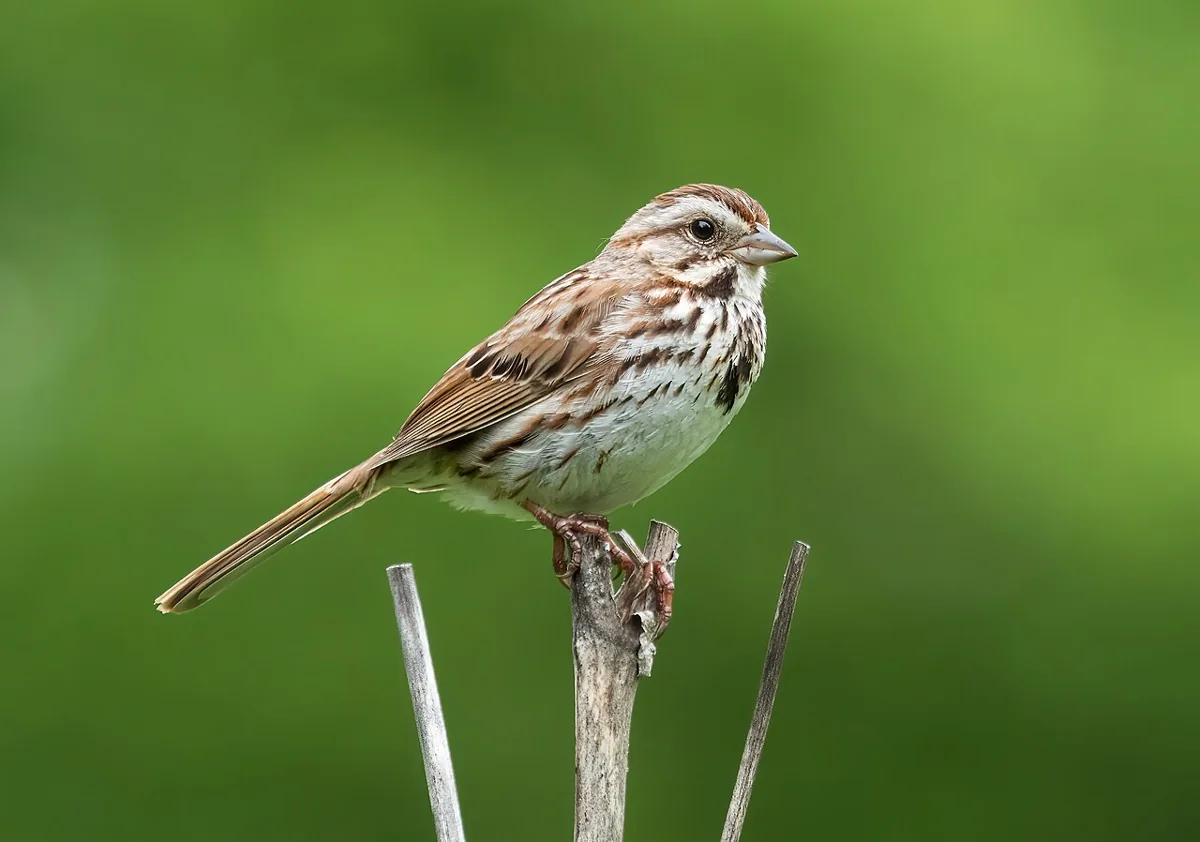
A bird disappears behind a building before you see its face. Another calls from dense shrubs while several species move nearby. These encounters can produce worthwhile records even when an exact identification remains unresolved. Keep the observation at the level the evidence supports, and make the missing information explicit. That gives you something you can revisit without converting an impression into a misleading fact.
Uncertainty can concern different parts of a sighting. You might know the species but be unsure of the number, or recognize a sparrow while being unable to name it. You might have a strong candidate and an important competing possibility. Describe each uncertainty separately. A vague question mark after a species name does not tell your future self which part of the observation needed checking.
Separate your observation from your candidate
Start with a plain account of what you saw or heard. Record body proportions, visible patterns, the kind of movement and any distinctive sounds. Mention an obstructed view or difficult lighting where it affected the clues. Then place your proposed identification in a separate sentence. This simple order helps you notice when the candidate rests on fewer observed features than you initially remembered.
A photograph can help, but it may hide the same problem as the original view. A bird facing away can have a clearly photographed back and an entirely unrecorded face. Review the image at its original quality before interpreting missing detail. A blurry patch does not demonstrate a field mark’s absence. Keep any later interpretation distinguishable from the notes you made during the encounter.
Choose the narrowest defensible label
A broad group label such as “sparrow species” can be appropriate when several species remain possible. A species-pair label can be useful when the evidence genuinely narrows the options to two. eBird provides formal group and pair categories for this purpose. Your private Tulipmane record accepts your own descriptive label, so you can explain uncertainty without needing to match a complete reporting taxonomy.
Only narrow a record to a pair after considering other realistic local candidates. A choice between two familiar birds can feel convincing while a third species has simply escaped your attention. Consult a regional guide for the location and season. If your knowledge of the group is still limited, a broader label with a good description is often easier to defend and more helpful for later learning.
Identify the clue that would change the decision
Write down the particular observation that could separate the remaining possibilities. For two similar woodpeckers it might be a usable side view of the bill or a clear look at the outer tail feathers. For a brown finch it might be the face pattern. “Need a better look” is understandable, but a named missing feature turns your next opportunity into a more focused observation.
Check whether the missing clue was genuinely unobserved or merely forgotten. If you saw the bird’s flank clearly and wrote that it was strongly streaked, that is evidence. If you never saw the flank, you cannot describe it as unstreaked. This distinction becomes particularly valuable after browsing reference images, when their obvious markings can accidentally become part of your memory of the encounter.
Give conflicting clues their own space
Sometimes several features support one candidate while another seems inconsistent. Do not erase the awkward detail simply to make the record tidy. Note the conflict and its viewing conditions. A color impression under backlighting deserves different weight from a repeated structural feature seen in good light. Individual variation, age, feather wear and hybrids can complicate identification, and some birds remain unresolved even for experienced observers.
Regional expectation is another source of tension. An unexpected bird is possible, but expectation alone cannot establish it. Ask whether a common species could explain the observation under the actual light and angle. If the unusual candidate remains plausible, preserve photographs or sound recordings from that encounter and describe the features that distinguish it from likely alternatives. Seek experienced review when appropriate.
Record confidence through an explanation
Numerical confidence can suggest more precision than your observation supports. A short explanation often communicates more. You might write that two field marks were seen repeatedly but the diagnostic call was unheard, or that the identification depends entirely on one distant photograph. These descriptions let someone assess the basis of the decision. They also show which part of the evidence a future sighting could improve.
The same principle applies to counts. If you recognized the species but estimated a moving flock, keep the species identification and count uncertainty separate. Explain whether birds crossed your view once or could have circled back. Avoid adding repeat observations together without considering that they might involve the same individuals. A careful record includes the scope of what you counted as well as the resulting number.
Revise a record while preserving its history
A later review may support a different name. In your private notes, retain the original observations and add the date and reason for the revision. Changing the label should not require changing what you originally saw. A second bird observed days later may teach you a distinction, but it cannot supply a field mark that was absent from the earlier encounter.
When you ask for help, share the original image or recording when possible, the approximate location and date, and a concise account of the view. Avoid sharing sensitive nest locations or private addresses. Explain which alternatives you considered. This gives a reviewer a defined question while preserving the context needed to notice a possibility outside the pair you initially proposed.
Keep the next observation manageable
Imagine a hypothetical brown bird feeding briefly below shrubs. You noted a conical bill and breast streaks, but its face stayed hidden. A record of “small streaked bird, possibly a finch” preserves a useful observation and a bounded candidate. A later walk can focus on face and body proportions. Naming it immediately would add certainty that the encounter never supplied.
Use the log to remember what to look for next, then return to watching. Some encounters will end with a species name and others with a group. Both can improve your observation skills when the description remains faithful to the view. The durable result is a record whose reasoning you can still understand months later, including the parts that remain open.
Keep exploring
Your first fifteen-minute bird walk
Run a small observation session with a clear start, route and note.
Set up binoculars before the bird appears
Adjust eye spacing, eyecups, focus and diopter in a repeatable order.
Find the bird before lifting binoculars
Transfer an unaided view to binoculars using landmarks and a steady stance.