
Look-alikes
American Crow or Common Raven?
Combine silhouette, tail, flight and voice without treating one cue as proof.
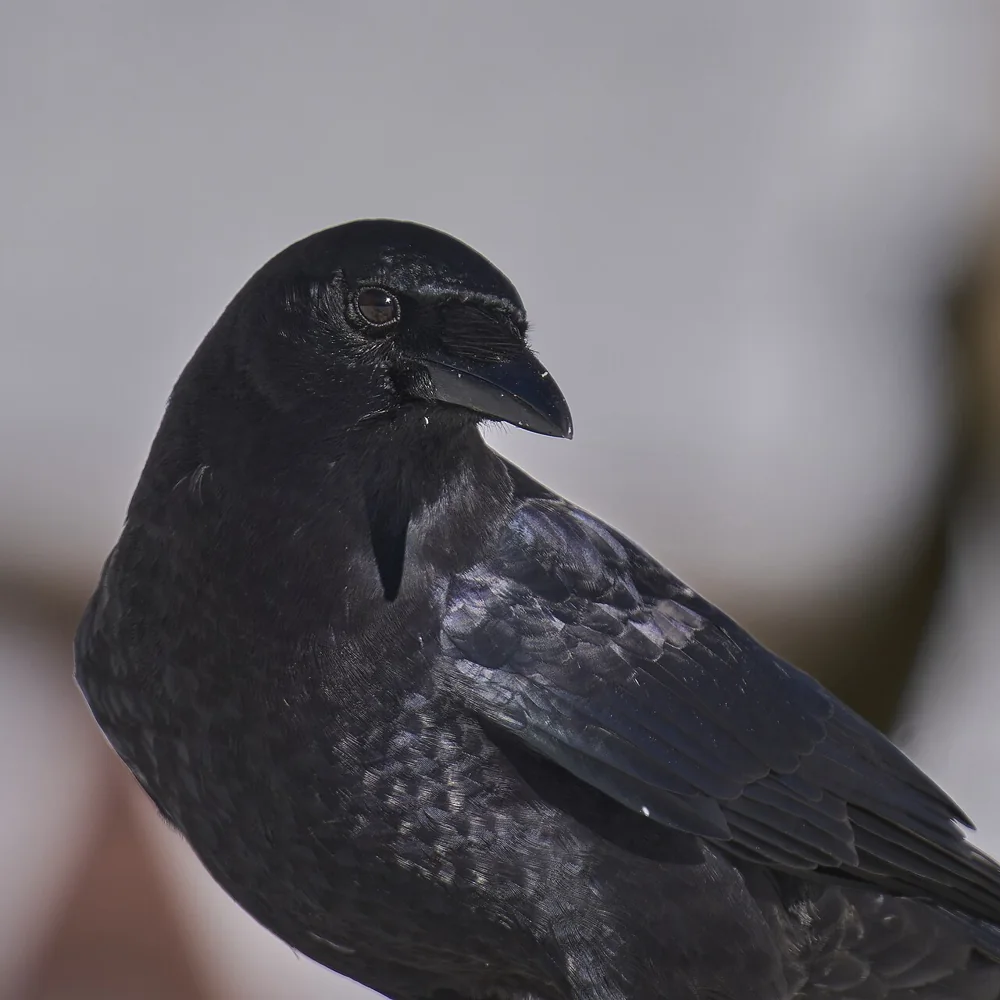
A large black bird above a neighborhood can be easy to notice and surprisingly difficult to name. American Crows and Common Ravens share dark plumage and broad adaptability. The familiar idea that ravens are larger helps most when the comparison is direct. For an isolated bird, look for a combination of head structure, tail shape, flight and voice that you can actually assess.
Begin with local possibilities. Fish Crow occurs in parts of eastern North America, and Chihuahuan Raven matters in parts of the Southwest. Other dark birds can also create a crow-like impression at distance. This guide compares American Crow with Common Raven, so a candidate that fits poorly should lead you to a regional resource instead of an increasingly forced choice between these two.
Use the best available kind of view
A perched bird may give you a useful profile of the bill and throat while concealing much of the tail. A flying bird can show the tail well but make the head too distant to judge. Treat these as different opportunities. Ask which features the encounter exposes clearly, then work with those features rather than insisting that every sighting provide the same checklist.
A photograph can preserve the view, but image scale changes apparent size. A tightly cropped crow can fill more of the screen than a raven photographed farther away. Compare proportions within the bird before comparing the size of two images. Keep the original files and context when possible, especially if the pictures were taken from different positions.
For a perched bird, study the head
Common Raven has a heavy, substantial bill. Its throat feathers can create a shaggy appearance that differs from the smoother impression of many American Crows. Look at the bill from the side and consider its depth and projection together with the head. The apparent thickness can change when the bird faces you, and ruffled feathers can alter the outline around the face.
American Crow has a strong bill too, so “large black beak” is an incomplete description. Describe how massive it looked relative to the head and whether you had a useful profile. A clear photograph can help compare that relationship with labeled regional references. If the head is silhouetted behind a branch, leave the finer bill distinction open.
For a flying bird, follow the tail
Common Raven typically shows a projecting wedge-shaped tail, while American Crow generally has a shorter, squarer or more rounded tail outline when spread. The difference can be striking in a good view from below. Watch more than one moment, because spreading, turning and banking change the silhouette. A tail held narrowly can hide the outline you expected to see.
Keep the bird’s flight position in your description. A brief side view with the tail partly hidden behind the body is weak evidence for its full shape. A sequence of photographs or a sustained underside view may show the outline more reliably. Do not interpret every triangular-looking dark shape as a raven when the angle conceals the individual tail feathers.
Observe flight as supporting evidence
Ravens often soar and can perform striking aerial movements. Crows also vary their flight according to activity and conditions. A bird soaring overhead can therefore suggest a line of investigation without proving the species. Compare the tail and head where visible, then add the flight description as another part of the record.
Describe the movement in terms you can revisit. Note a sustained glide, repeated wingbeats, a bank or a tumble. Avoid replacing those observations with a personality label such as “playful” as your main evidence. The movement itself can be checked against references, while the motivation behind an individual maneuver may remain unknown.
Connect the voice to the visible bird
The familiar repeated caw is associated with American Crow, while Common Raven commonly gives deeper, croaking sounds. Both have varied vocal repertoires. Learn from multiple labeled recordings and visible birds, rather than expecting every call to match one written syllable. Background noise and distance can affect the impression of pitch and roughness.
If several birds are present, confirm which one is calling. A raven-shaped bird overhead and a crow calling from trees below can otherwise combine into a misleading record. Watch for the bill or throat moving with the sound when the distance permits it. If you cannot connect sound and bird, record them as separate observations until additional evidence links them.
Be cautious with group size and habitat
Crows can gather in large communal roosts outside the nesting season, and ravens are often encountered in pairs. Those tendencies do not create an identification rule for every group. One crow can be alone, and several ravens can occur together. The number of birds helps describe the encounter, but it cannot replace bill, tail and sound evidence.
Likewise, a city setting does not automatically mean crow, and a wild landscape does not automatically mean raven. Both species use a range of habitats, and local distribution changes over time. Consult a current regional map for expectation. Then evaluate the individual bird with the view you have, particularly when it seems surprising for the neighborhood.
Resolve the decision or preserve the gap
A coherent set might include a heavy bill in profile, a shaggy throat and a clear wedge tail, supporting Common Raven. Another encounter might show a squarer tail and repeated caws connected to the visible bird, supporting American Crow. The goal is agreement among useful clues. It is reasonable to keep the identification broader when the supporting observations remain weak.
For example, imagine a hypothetical distant bird that glides past once with its tail closed. “Large black bird, crow or raven, tail shape unresolved” preserves the view better than a confident raven label based on gliding alone. Write the missing feature while you remember it. Include the date, approximate place and whether the sound came from the bird you were following. The next encounter then has a concrete question to answer, instead of merely repeating the same uncertain size impression.