
Look-alikes
American Robin or Eastern Towhee?
Separate orange-sided ground birds using posture, bill and color placement.
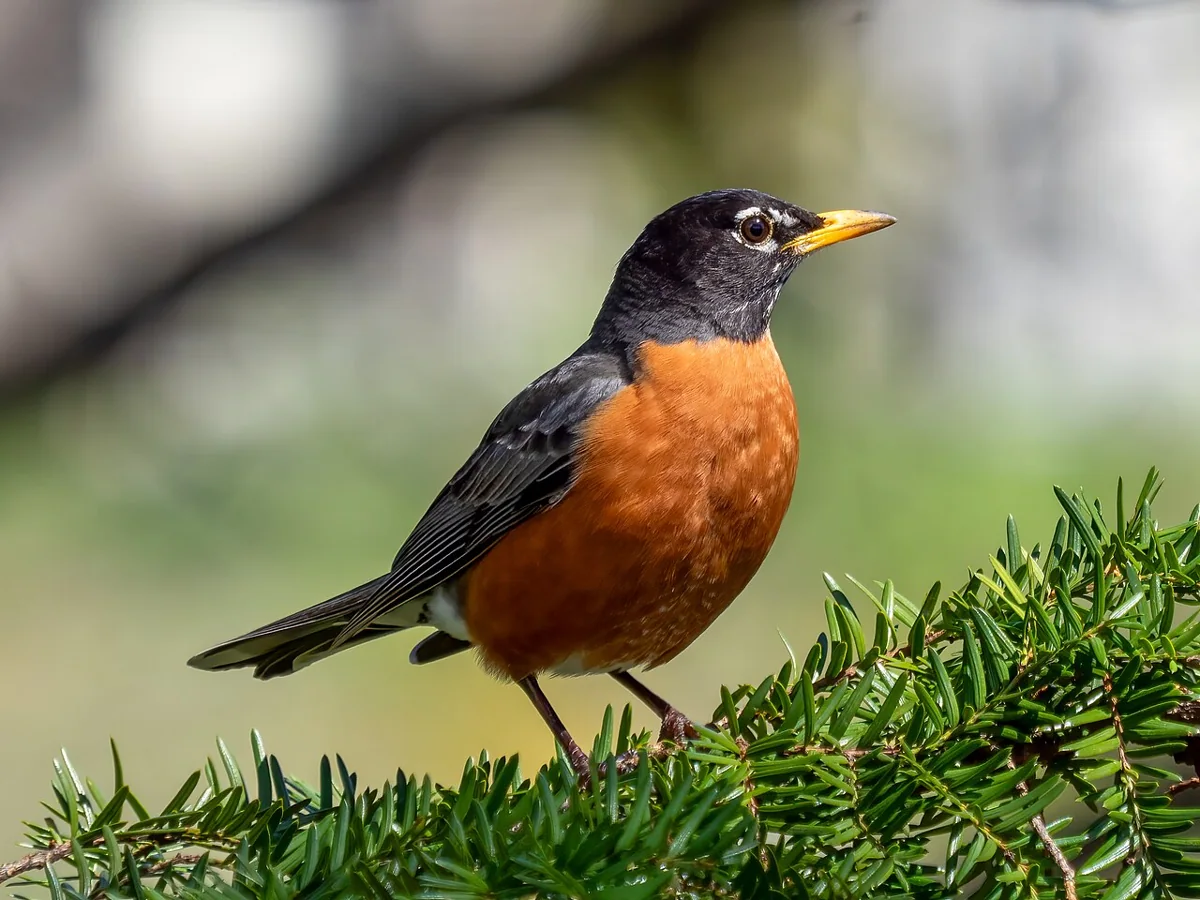
An orange-brown area on a bird feeding near shrubs can suggest American Robin or Eastern Towhee, but the location of that color matters more than the color word alone. A robin’s warm color extends broadly across the breast. A towhee’s warm sides frame a paler central belly beneath a dark or brown upper body. Find that arrangement before deciding how orange the bird looks.
This comparison applies where Eastern Towhee is a realistic candidate. Towhees in western regions may require comparison with other species, especially Spotted Towhee. American Robins also vary regionally and seasonally in their local presence. Use the location and date to choose relevant references, then inspect the individual bird rather than letting geography stand in for visible features.
Map the underparts from the center outward
Try to see the center of the breast and belly as well as one side. An Eastern Towhee has rusty sides separated by a conspicuous pale central area, with a darker hood above. An American Robin generally shows a more extensive warm-colored breast and a gray back. A frontal or three-quarter view can make this distinction easier than a brief profile.
A pure side view may emphasize only the towhee’s rusty flank, concealing the pale central belly. That is one reason the initial orange-bird impression can be misleading. Wait for an ordinary turn if the view continues. If the center remains hidden, keep the observed side color and the missing region separate in your description.
Compare the bill and body plan
A towhee’s bill looks relatively stout and conical. A robin’s bill is slimmer and straighter, fitting the familiar thrush profile. Look at the bill from the side rather than directly in front. Combined with the underpart pattern, that structural difference can help you distinguish two birds that both spend time close to the ground.
American Robins often appear relatively long-legged and upright during pauses on lawns. Towhees have a different balance of compact body, stout bill and extended tail. Posture can change quickly, so compare more than one moment. A crouched robin should not be treated as a different body plan simply because it lowered itself to reach food.
Inspect the head and back
Male Eastern Towhees typically have black upperparts and a dark hood, while females have brown upperparts and a brown hood. Both retain the contrasting warm sides and pale central underparts. A female can consequently look less dramatic than the male illustration without losing the larger pattern that makes the species recognizable.
American Robins have gray upperparts and can vary in how dark the head appears. Adult males often look richer than females, but the difference is subtler than the familiar male and female towhee contrast. Avoid identifying sex from brightness alone. The species comparison should be coherent before you attempt a finer age or sex interpretation.
Watch the tail when it opens
Eastern Towhees have conspicuous pale corners on the tail that can show during movement. A short flight or natural fan may reveal them after a perched view concealed the outer feathers. Robins can also show pale marks around tail corners, so white in the tail is supporting context rather than an exclusive shortcut between these two species.
Describe both the position and scale of the pale area. A bright flash from the tail differs from a broad white patch on the body. Keep the bird in view through the movement if possible, and avoid combining a tail flash from one individual with a breast pattern from another in the shrubs.
Use ground behavior carefully
Robins commonly feed across open lawns, moving and pausing as they search. Towhees often work in or near low cover and leaf litter. Watching where and how the bird feeds can therefore direct your attention to a candidate. The habits overlap enough that a single action should not replace the plumage and bill comparison.
A bird scratching among leaves may be difficult to inspect because its head repeatedly disappears. Wait for a pause and use that view to check the body pattern. Do not approach or disturb the cover to make it emerge. A quieter position can preserve the behavior and may eventually provide a better angle as the bird moves naturally.
A young robin changes the familiar picture
Juvenile American Robins show spotting beneath and mottling above, so the clean adult breast may be absent. Compare their underlying shape and the distribution of warm color with a labeled juvenile reference. A spotted young bird does not automatically establish robin, since other local thrushes may also have spotted underparts.
For any unfamiliar young-looking bird, broaden the reference set before narrowing the name. If the view lacks the features needed to distinguish a young robin from other candidates, keep the uncertainty. An adult nearby may provide context, but it should not lend its identity automatically to every bird in the same patch.
Sound can provide another connection
Robins are familiar for their flowing song phrases, while Eastern Towhee songs often end in a sustained trill after introductory notes. Both have additional calls, and songs vary. Learn from labeled recordings appropriate to your region. A written mnemonic can help memory, but the pattern and the confirmed caller matter more than whether you hear the suggested words.
Connect sound to the visible individual whenever possible. A robin on open grass and a towhee hidden in nearby shrubs can occur in the same scene. The visible bird is not necessarily producing the voice you hear. Keeping those observations separate prevents an otherwise clear plumage comparison from acquiring contradictory borrowed sound evidence.
Put the two strongest clues together
A broad rusty breast with gray upperparts and a slimmer bill supports American Robin. Rusty sides framing a pale belly, a darker hood and a stout bill support Eastern Towhee. If the warm area is all you saw, record where it appeared and which body regions remained hidden. A later natural view of the center of the underparts may resolve more than another attempt to name its precise hue.