
Look-alikes
House Sparrow or House Finch?
Sort familiar brown birds by bill, face and underpart pattern.
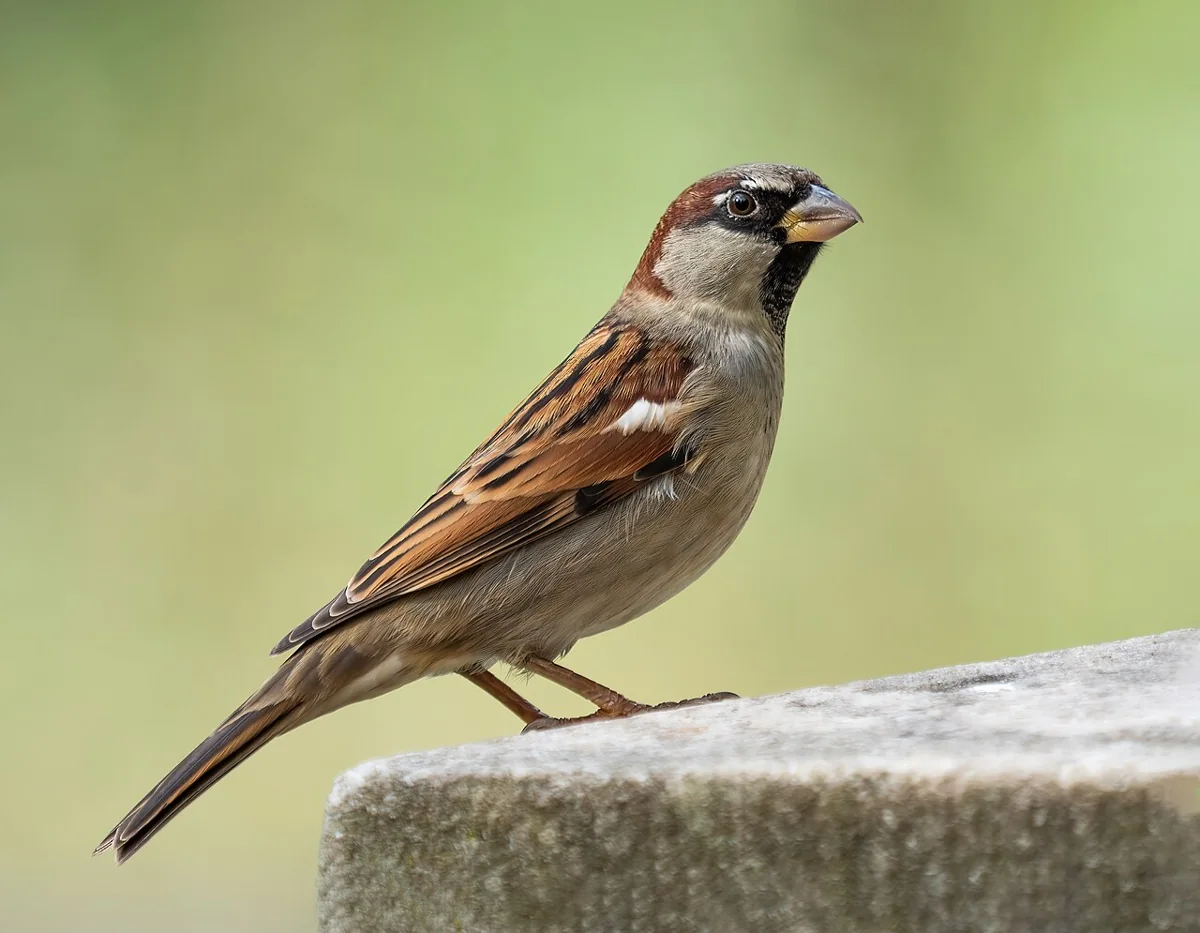
At a busy feeder, a brown bird with a short bill may disappear behind another bird before you notice its face. House Sparrows and House Finches both fit that first impression and often share settled neighborhoods. Their clearest differences lie in the arrangement of marks, especially the face and underparts. Inspect one bird long enough to connect those areas on the same individual.
The comparison becomes easier if you first decide whether you are looking at a strongly marked adult male or a quieter brown bird. That choice determines which reference photographs will help. A brown House Finch should not be rejected for lacking a red breast, and a female House Sparrow should not be expected to display the familiar male’s dark throat patch.
Start with the breast of a brown bird
Female and young House Finches generally show streaking across pale underparts. Female House Sparrows have a comparatively plain grayish or buff-toned chest. A clear breast view can therefore provide an effective first separation. Look for repeated dark lines within the feathers rather than shadows cast by the feeder or the bars of a nearby fence.
Side views help too, because the finch’s streaking can remain visible along the flanks. A bird facing away may expose only its patterned back, which is much less useful for this particular question. Both species can look streaked above. Specify whether you saw the back, breast or side before applying the plain-versus-streaked distinction.
Then compare the face
A female House Sparrow usually has a pale eyebrow that contrasts with the crown and cheek. A female House Finch typically has a plainer brown face. The difference is relative, so inspect the pattern’s placement and strength rather than expecting one bird to have a perfectly blank face. Shade can suppress contrasts that a well-lit photograph shows clearly.
Face and breast make a useful combination. A pale eyebrow with plain underparts supports female House Sparrow, while a relatively plain face with conspicuous breast streaking supports House Finch. If you saw only one region, retain that limitation. Other local small brown birds may fit part of the pattern, and the pair should not become an artificial limit on your search.
Adult males usually offer stronger contrasts
A typical adult male House Sparrow combines a gray crown, pale cheek, chestnut behind the head and a dark throat or bib. A red-fronted male House Finch has colored areas on the face and upper breast, with brown elsewhere and streaking along the lower sides. Compare that overall arrangement instead of choosing between “brown” and “red.”
Some male House Finches show orange or yellow in place of red. The species account documents that variation, so the exact warm hue should not override the remaining pattern. A dark throat seen in shade also needs checking before it becomes a sparrow bib. Give the bird time to turn naturally if a brief view leaves the contrast uncertain.
What the bill can and cannot resolve
Both species have short, conical-looking bills. That shared structure helps place the bird among plausible seed-handling candidates, but it rarely settles the pair for a beginner. A fine side view may support the overall comparison, while a direct frontal view can make both bills seem broad and blunt. Use the face and underparts as more approachable pattern questions.
A bill described only as “thick” also fits other local finches and sparrows. Consult a regional guide if the rest of the bird conflicts with both candidates. House Finch and House Sparrow are familiar, but they are not the only small brown birds in parks. Repeated mismatch is a reason to widen the list, especially near vegetation that supports native sparrows.
Keep the two evidence regions together
| Region | Typical brown House Sparrow | Typical brown House Finch |
|---|---|---|
| Face | Noticeable pale eyebrow | Relatively plain brown |
| Breast and sides | Mostly plain | Dark streaks on pale ground |
| Back | Patterned brown | Patterned brown |
The shared patterned back explains why a rear view is often frustrating. The table also shows why “brown and streaky” needs a location. Streaks on the underparts provide different information from streaks on the back. If a photograph records only the rear, keep the identification open until another feature or another view contributes enough evidence.
A feeder can mix several appearances
Track one individual through a turn before combining its marks. A feeder can hold a red male finch, a brown finch and several sparrows at once. Looking from one head to a different bird’s breast can create a composite that fits neither species. Choose a location on the feeder as a temporary reference and follow the bird when it moves.
If the flock departs, avoid assuming every brown bird belonged to the species you identified confidently. Your record can include confirmed House Sparrows, a confirmed finch and additional unresolved small birds. This preserves the real composition of the encounter. It also prevents one conspicuous male from lending his identity to several individuals you never examined.
Use voice and surroundings as context
Both can make simple chirping sounds, so a generic chirp adds little to this comparison. A clearly connected, familiar song may help after you have learned it from reliable recordings. Confirm the caller when possible. A finch singing above a feeder and a sparrow visible below it should not be combined into one identification.
Buildings, lawns and feeding areas suit both species. House Sparrows are strongly associated with human structures, while House Finches also use varied open and semi-open settings. Those tendencies help establish expectation but do not replace plumage. A plain-chested bird does not become a sparrow merely because it landed on a building, nor does a bird on a plant automatically become a finch.
Choose the missing view
If the breast is clear but the face is hidden, a natural head turn may be the most valuable next event. If the face is visible but the feeder conceals the body, wait for the bird to move without disturbing it. A narrowly defined question makes the comparison easier. When the encounter ends first, save the observed pattern and leave the name at a broader level.