
Seasons & habitats
Watch birds around a park pond
Observe water, shore and vegetation without assuming all waterbirds are ducks.
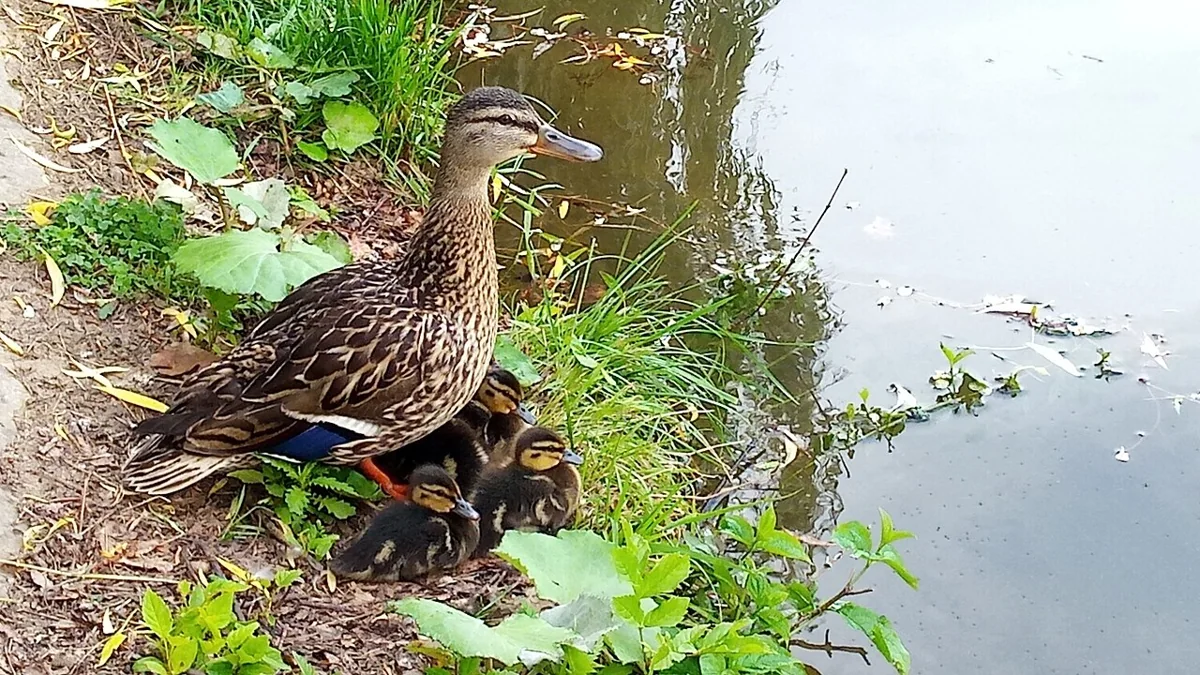
The ducks in the middle of a pond may be its most obvious birds, but they show only part of the habitat. The shallow margin, wet ground, reeds, nearby lawn and overhanging branches can support different activities. A careful scan moves through these zones deliberately. It gives you more chances to understand what each bird is doing without walking the entire shoreline.
Choose a stable permitted viewpoint with a clear route away from the bank. Stay behind barriers and avoid steep, icy or unstable edges. Access and visibility vary between parks, so check current local information rather than assuming a mapped path reaches the water. A bench or raised public overlook can provide a useful view while keeping you well clear of birds using the margin.
Start with the nearest visible edge
Look along the meeting of land and water before concentrating on the open surface. Small movements can be easier to notice against a fixed shoreline. A bird might search mud, pause in shallow water or move between grass and the bank. Note the substrate and action before deciding that everything near the water belongs to the same feeding group.
The shoreline may be partly hidden by plants. Treat those hidden sections as unobserved habitat, rather than empty space. A bird entering cover can remain nearby while disappearing completely from your count. If it reappears, consider whether you may be seeing the same individual before adding another. The boundary of your visible area matters as much as the boundary of the pond.
Compare shallow-water actions
Some birds wade and search while standing in shallow water. Others feed at the surface, reach down from a swimming position or tip forward with the tail raised. Mallards commonly dabble and up-end, while Canada Geese can graze on land and reach underwater. A feeding action helps organize the observation, but it does not independently identify every bird that uses it.
Watch for the connection between water depth and movement. A long-legged bird at the edge may use a different area from a swimming bird farther out. You can describe the visible relationship without measuring depth or identifying the prey. “Stood near the margin and struck downward once” preserves more evidence than an assumed fish capture when the bill was hidden at the critical moment.
Give vegetation its own scan
Emergent plants and dense bankside shrubs create cover that can be difficult to inspect. Listen for a sound, then watch for movement at openings. Red-winged Blackbirds may be conspicuous on stems while other birds remain mostly concealed. The visible bird is a starting point, not proof that the cover contains only that species.
Keep your distance from birds carrying food or repeatedly returning to a concealed point. A productive pond can include breeding habitat as well as feeding areas. Avoid moving reeds or entering closed margins to improve a view. If the only possible observation requires disturbing dense cover, choose another visible zone and let that part of the pond remain beyond your inspection.
Move outward to open water
Scan the surface in a consistent direction, using landmarks on the opposite shore to keep your place. Separate obvious groups before examining individual birds. Some may rest, others feed, and others swim between groups. A narrow binocular view can make this movement confusing, so periodically check the whole scene with your unaided eyes.
A bird that dives can disappear and surface away from its original position. Watch the surrounding area before treating the next appearance as another individual. If several similar birds dive at once, count only as accurately as the view allows and note the difficulty. The absence of a bird from the surface does not establish that it left the pond.
Look above and beside the water
Birds may use branches, posts or open air around a pond. A perched bird can watch the water, while another catches insects over the surface. These observations broaden the scene beyond swimming waterfowl. Follow the action to its endpoint where possible, and keep a direct capture separate from a flight that merely passes over the pond.
Nearby lawns can be part of the same observation setting. Geese may move between grass and water, creating repeated appearances along your scan. Keep those movements in mind when totaling birds from the two zones. If the visit is casual, a clear minimum count with a movement note can be more defensible than an exact-looking total assembled from every sighting.
Expect different ponds to support different birds
Research on constructed ponds shows that habitat features relate to the kinds of waterbirds using them. Shallow areas, vegetation, trees and open water can serve different groups. A study from southwest Florida provides evidence for that principle, while its species mix and numbers belong to its own location and study period. They cannot predict a pond visit elsewhere on the continent.
For your local visit, examine what is physically present. A steep walled basin differs from a pond with a gradual vegetated margin. Seasonal water levels and ice can change the available zones. Record the conditions you saw so a later visit can be compared sensibly. A quieter day may reflect changed habitat use, detection or movement rather than a simple decline.
Include any fountains, heavy glare or dense shoreline cover that affected the scan. Those features can explain why a later observer obtained a different view.
Finish with a zone-based note
List the species you identified and the zones where you observed them. Add the main action for a few clear birds, such as grazing, dabbling, wading or diving. A hypothetical note could distinguish Mallards on open water from geese grazing nearby and an unresolved bird moving through reeds. That organization helps you remember what was visible and where the gaps remained.
Keep food and other attractants out of the exercise, and follow the park’s wildlife rules. Watching naturally occurring movements gives you a more informative view of how birds use the pond. On a return visit, scan the same zones in the same order. You can then notice a new behavior or habitat change without needing to convert every visit into a larger species list.
Keep exploring
Read a range map as a starting point
Combine season, region and local habitat rather than treating a boundary as a fence.
Why migration dates vary from place to place
Interpret broad seasonal patterns without promising an arrival date.
Find the small habitats inside a city park
Plan an accessible observation route across lawn, edge and canopy.