
Look-alikes
European Starling or Common Grackle?
Read proportions and seasonal plumage before judging glossy color.
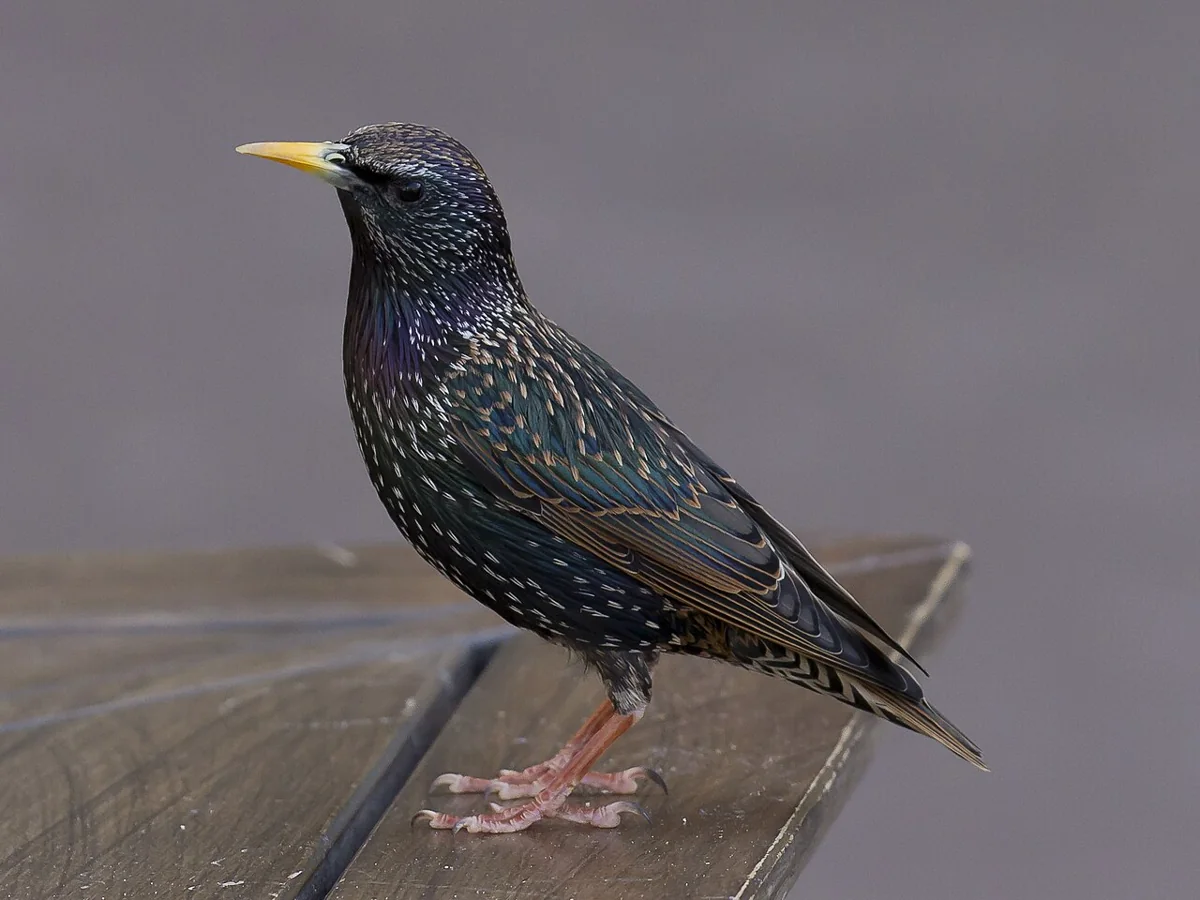
A glossy dark flock on a lawn can contain birds with very different proportions. European Starlings have a compact, short-tailed appearance. Common Grackles usually look more elongated, especially because of their long tails. Start there before trying to decide whether a reflection looks blue, purple or green. The gloss can change as a bird turns, while a useful side view preserves its structure.
Both species can use parks, fields and neighborhoods, and mixed groups are possible. Choose one bird and compare its head, body and tail together. If you glance between individuals, a long tail from one and a spotted breast from another can become a misleading memory. Individual tracking matters as much as the choice of identification mark.
Compare the tail with the body
A starling’s tail is short relative to its body. A typical grackle’s tail projects much farther behind it and can show a distinctive folded or keeled appearance in some views. Watch the bird side-on, with the tail clear of grass or surrounding birds. A head-on bird can hide the very feature that makes this comparison approachable.
The grackle species account notes that birds replacing feathers in late summer can have shortened or ragged tails. A short-looking tail at that season therefore needs additional evidence. Look for the actual outline and condition rather than assuming every bird has a complete tail identical to an adult guide image. A partly concealed tail is also different from a visibly short one.
Look at the bill and head
European Starlings have a relatively thin, straight bill, while Common Grackles show a stronger bill on a longer-headed outline. The difference becomes easier once you have compared several labeled profiles. A bill pointing toward you may appear short and deep, so do not compare it directly with a side-facing reference. Wait for the bird to turn if the view remains comfortable.
Many adult Common Grackles have conspicuously pale eyes. That can add a useful point when the head is close enough to inspect. Juveniles have dark eyes, so the absence of a pale eye does not exclude grackle. Glare can also create a bright point on a dark eye. Check the feature across more than one moment.
Expect the starling’s plumage to change
In fresh fall plumage, European Starlings can be heavily speckled with pale tips. As those tips wear, the bird can look darker and glossier. A heavily spotted winter starling and a sleek breeding-season starling may therefore create very different first impressions. Tail and bill proportions help connect the seasonal appearances.
Bill color changes too. A familiar bright yellow bill belongs to the breeding appearance, while birds at other seasons can have duller bills. Avoid making yellow a requirement for every starling encounter. Date helps you choose the reference images, and the full pattern determines whether the candidate fits.
Common Grackles also vary in glossy color, including regional differences in how the body contrasts with the head. A shiny blue head is compatible with grackle but is not an exclusive identification feature. Both birds can look nearly black in poor light. Record the contrast you saw, then return to the structure and other marks that separate them.
Brown juveniles complicate a dark-bird rule
Young European Starlings can be largely dusty gray-brown with dark bills, looking unlike a glossy adult. The short tail and overall body plan remain useful. A flock with brown and glossy individuals may include different ages of the same species. Inspect their proportions and compare labeled juvenile images rather than assuming each color represents a different species.
Young Common Grackles may also be less glossy and lack the pale adult eye. When both familiar adult shortcuts are missing, tail length and the head-and-bill profile become especially valuable. If those parts are hidden, a broad dark-bird or grackle/starling description may be the most defensible private record until a clearer view becomes available.
Follow the transition into flight
A departing starling can show pointed wings on a compact body. A grackle’s longer tail can remain conspicuous as it flies or lands. Watching a bird leave the lawn can therefore add evidence you missed while it was feeding. Keep the individual in view through the transition so the flight shape stays connected to the perched bird.
A fast distant flock may be harder to identify than a single resting bird. Shape changes with banking, wingbeats and tail spread. Learn the flight impression from birds you first identified well on the ground. That creates a firmer association than trying to memorize an overhead silhouette whose identity was uncertain from the start.
Sound can help after you know the caller
Grackles can give harsh, squeaky sounds, while starlings have a varied mixture that may include whistles, rattles and mimicry. These broad descriptions overlap in an ordinary noisy flock. Connect a sound to a visible caller before treating it as species evidence. A familiar sound from somewhere in a group does not identify every bird in it.
Use several reliable recordings to learn a common local sound from each bird. Listen for the phrase and tone rather than relying on a colorful written comparison. If sound remains the only clue, preserve a recording when possible and keep the uncertainty explicit. A vague impression of squeaking adds less than a clear long-tail view.
Widen the list when necessary
Common Grackle is one member of a wider set of dark birds. Other grackles occur in parts of the continent, and local blackbirds can share lawns or wetlands with starlings. A bird with an exceptionally long tail or a conflicting body pattern deserves regional comparison. This page is a focused pair guide, and it cannot replace the full local candidate list.
Finish by identifying which observation actually separated the pair. A short tail, straight bill and visible speckling form a coherent starling case. A long tail, strong bill and pale adult eye form a coherent grackle case. Missing or contradictory parts should send you back to a better view or a broader label, preserving the encounter’s real evidence.