
Behavior
Watch how a bird finds its food
Recognize gleaning, probing, ground feeding and aerial pursuit.
A bird can spend a minute searching for food without showing you a single recognizable mouthful. Its movements still offer information. Watch where it searches, how it reaches the surface, and whether you actually see a capture. Those three observations make foraging behavior easier to understand, even when the bird remains partly hidden or you cannot identify the food.
Foraging describes the process of finding and obtaining food. A species can use several methods, and the method can change with season, habitat and the opportunity in front of it. Learning a few action words helps you describe an encounter. The words become useful when you connect them to visible movements, rather than assuming a bird must perform the technique associated with its family.
Begin with the surface being searched
Choose a relaxed bird that is already visible from a permitted path. Look at the physical setting around its bill and feet. Is it moving across grass, inspecting the underside of leaves, working on bark or watching open air? A note such as “searched beneath twigs” records a more specific place than “fed in a tree.” It also helps explain why the same species may move differently elsewhere.
Keep the observation small. Follow one bird for a short uninterrupted period instead of switching whenever another bird appears. Watch how it moves between searching positions and where it pauses. If foliage blocks the bill, you can describe the search without claiming a successful capture. A bird’s repeated attention to one surface suggests a foraging opportunity, but the prey itself may remain invisible.
Recognize picking from an exposed surface
Gleaning involves taking small prey from a surface such as foliage or bark. A Black-capped Chickadee inspecting twigs may reach around them or hang underneath to access another side. The body movement helps place the bill where the food is. You might see a quick pick and an apparent swallow, or you might see only the approach and inspection.
Describe the level you observed. “Picked at three leaf undersides” is dependable even when the objects were too small to resolve. “Ate three caterpillars” requires a clearer view of what was taken. Keep your description of the action separate from your proposed food identification. This distinction matters when the bird is working quickly and several small movements blend together.
Distinguish probing from pounding
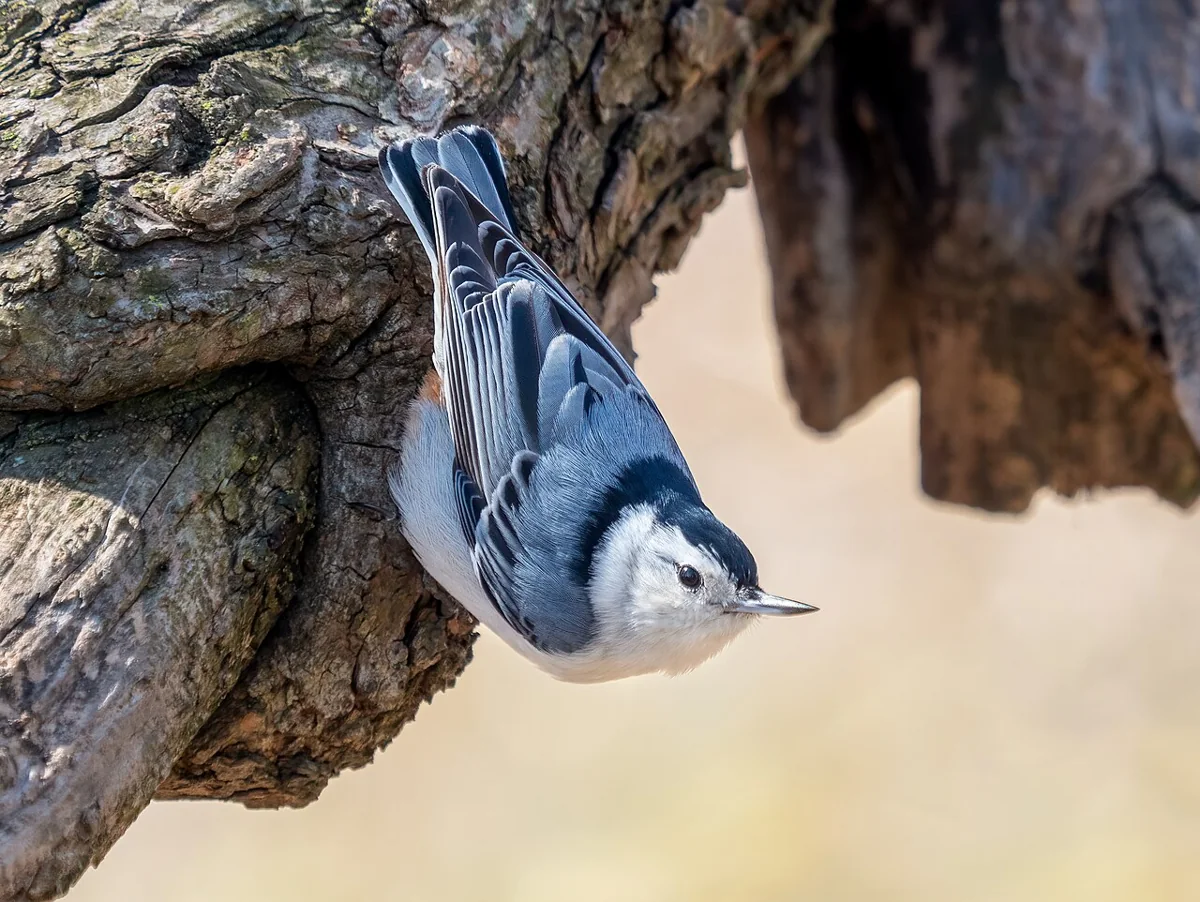
Probing takes the bill into a crevice, soft ground or another opening while the bird searches. Excavating or pounding can remove material to reach food beneath a surface. A woodpecker can use both approaches during one feeding session. A White-breasted Nuthatch explores tree trunks and larger limbs, sometimes reaching into bark crevices. The exact food need not be visible for you to recognize the different actions.
Listen as well as watch, but avoid treating every tap as feeding. Woodpeckers also drum to communicate and excavate cavities. A useful feeding observation includes what happens between strikes. Does the bird pause and inspect a spot, remove material, or take something into the bill? A rapid repeated drumroll on a resonant surface has a different context from deliberate searching at several points.
Compare ways of feeding on the ground
An American Robin often runs across a lawn, pauses and directs its attention downward. A Northern Cardinal may hop while searching at ground level or among low shrubs. These broad movement differences can help you follow birds before studying finer field marks. They do not establish a species by themselves, because several birds can use the same general feeding area.
Watch the whole sequence around a possible capture. A pull from the ground, a brief handling movement and a swallow can be separate events. If the object disappears behind grass, keep its identity open. Robins eat more than earthworms, and their diet also includes insects and fruit. A bird standing on a lawn does not prove what it found there.
Watch where an aerial movement ends
A bird leaving a perch may pursue an insect in open air, move to another lookout or simply depart. Follow its path if you can do so safely from where you stand. A short outward flight followed by a return can be consistent with aerial foraging, but seeing the bill take prey supplies stronger evidence than the flight pattern alone.
Some species switch between feeding from a perch and searching below it. Northern Mockingbirds can watch from low perches and drop to the ground for food, as well as walk and run while feeding. Compare the endpoint with the starting position. The outward movement may take your attention, while the brief landing or handling action explains what the bird was doing.
Keep technique separate from diet
A thick bill, a probing action or an aerial chase can suggest possible foods, but each leaves uncertainty. Birds may take different food types with similar motions. A familiar species can also use a technique you have never noticed before. Describe the physical action first, then check a species account for the range of feeding methods and foods documented for that bird.
Season adds another layer. A species that takes many insects in summer may use seeds or fruit more heavily at another time. A comparison between two visits should therefore include date and setting. Avoid concluding that one session reveals an individual’s entire diet. It shows how that bird searched in the conditions you happened to observe.
Build a three-part behavior note
Record the action, the surface and the visible outcome. A hypothetical example would be “nuthatch explored trunk crevices head downward, inserted bill repeatedly, food item unseen.” Another could read “robin ran across short grass, paused, pulled a visible worm and swallowed.” These notes have different levels of certainty because the views supplied different information. Both preserve a complete observation at their own level.
On a later walk, compare those same three parts for a different bird or habitat. You may find several species sharing one tree while searching different surfaces. You may also discover that the same bird changes methods within minutes. Learning these variations makes a familiar park easier to read and gives you specific behavior to recognize alongside shape, pattern and sound.
Keep exploring
Drumming is more than a woodpecker finding food
Distinguish display drumming from feeding sounds and avoid false acoustic IDs.
Make sense of a mixed flock
Follow movement layers and separate species without chasing the flock.
Why small birds mob a larger bird
Interpret alarm gatherings without approaching or exposing a predator.