
Behavior
Why a bird carries food away
Separate immediate feeding, caching and feeding young with cautious notes.
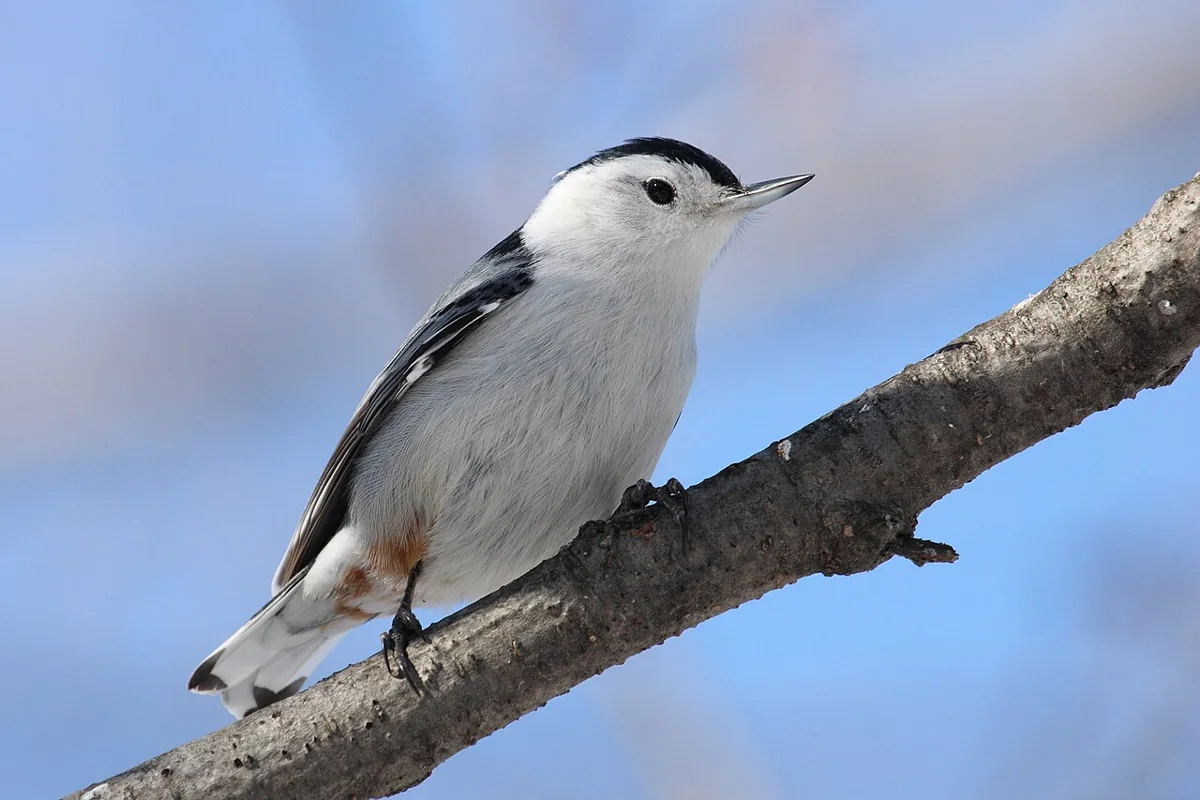
A chickadee takes a seed, flies to a tree and disappears behind a branch. It may be storing food, but the departure alone cannot tell you that. It could also be opening the seed in another place or carrying it to another bird. Follow the visible endpoint when you can, and keep the explanation open when the food leaves your view.
Caching means putting food aside for later use. Several familiar North American birds do it, including chickadees, nuthatches and jays. Their storage sites and handling methods differ. Learning the behavior gives you another way to understand birds around a home or park, while a careful observation sequence prevents every repeated feeder trip from becoming a claim about food storage.
Start with what was carried
Notice the item before the bird moves away. A whole seed, an exposed kernel and an insect can require different kinds of handling. You may see the object clearly, or only a small shape in the bill. Use a description that matches the view. “Carried a pale object” can be accurate when “carried a sunflower seed” would depend on assumptions.
Keep the bird in view without following it closely. If it moves behind cover, note the direction and let that part of the sequence remain unknown. A distant look can still show whether it lands on a branch, descends to the ground or approaches another bird. Those endpoints provide more information than simply counting how often it returned to the original food source.
Handling a seed can resemble hiding it
Some birds take food to a perch where they can hold and open it. You may see repeated bill strikes, pieces falling, or a final swallow. A seed wedged in bark can be a convenient object to work on rather than a cache. The difference concerns what happens next. Watch whether the bird consumes it, leaves it in place, or moves it again.
A brief pause creates uncertainty. A bird may put an item down while adjusting its grip, then pick it up immediately. Record the visible placement and retrieval instead of assigning a long-term purpose. If the view ends before the outcome, describe that boundary. One clear sequence is more valuable than a confident interpretation built from several incomplete feeder departures.
Look for a stored item left behind
Chickadees and nuthatches can place food in small crevices, and Blue Jays store acorns in the ground. A bird inserting an item into a site and leaving without it provides evidence consistent with caching. Some birds cover stored food with material. You do not need to inspect the site yourself to make a useful note about the visible action.
Leave bark, leaves and soil as you found them. Opening a crevice or moving a covering would change the cache and potentially expose it to other animals. Mark the place broadly in a private description if that helps your memory. A photograph from your existing viewpoint can preserve context, but there is no need to publish an exact small storage location.
Carrying food can involve another bird
During breeding, adults may carry food to young or to a partner. Some courtship behavior includes one adult feeding another. A bird leaving with food therefore does not establish storage, even if you have seen the same species cache at another time. Watch for an actual transfer if the scene is naturally visible without approaching a nest or dependent young.
If the bird repeatedly disappears into dense vegetation, retain the uncertainty and give the area space. Do not trace its route to find the recipient. You can write that repeated food-carrying trips occurred without identifying their destination. The record can remain useful as behavior evidence while avoiding a disturbance that would reveal more than you need to know.
Why storing food can be worthwhile
Caches can provide food when immediate supplies are harder to obtain. Birds that store items can distribute them among many sites, and spatial memory helps them return. Stored food can also be taken by other animals. The value of a particular cache depends on the food, the storage site, the time before use and what happens around it.
Different species solve these problems in different ways. A fact about the memory or storage capacity of one jay or tit species cannot automatically be transferred to a local Blue Jay or chickadee. When reading a source from another continent, check the species name. Use regional accounts for the bird in front of you, especially when the claim includes a quantity or timescale.
A return visit adds evidence, with limits
You may later see a bird retrieve food from the same general crevice. That strengthens the interpretation that the site was used for storage, but it may not identify the individual that originally placed the item. Several similar birds can use one tree. Keep the placement, retrieval and individual identity as separate parts of the record.
Do not assume that every disappearance means an item was recovered successfully. A different animal might take it, the bird might move it, or your next view might miss the exact site. The absence of visible food does not reveal the whole history. A repeated observation works best when it records a new action rather than filling the gap with a story.
Describe the sequence in four steps
Use acquisition, transport, placement and endpoint as a memory aid. A hypothetical record might read “nuthatch took one seed, carried it to a trunk, inserted it beneath loose bark, then left with an apparently empty bill.” That supports a cautious caching interpretation. If the last two steps were hidden, the same encounter would support only a food-carrying observation.
Keep counts modest when several birds are involved. Repeated trips show activity, while the number of individuals can remain uncertain. On a later visit, choose one clearly visible sequence rather than trying to explain every departure. You will begin to distinguish eating, handling, storing and transferring food through observed actions, with enough detail to review your interpretation afterward.
Keep exploring
Watch how a bird finds its food
Recognize gleaning, probing, ground feeding and aerial pursuit.
Drumming is more than a woodpecker finding food
Distinguish display drumming from feeding sounds and avoid false acoustic IDs.
Make sense of a mixed flock
Follow movement layers and separate species without chasing the flock.